

The European Union, together with several larger aircraft manufactures, has an ambitious goal: to make hydrogen-fuelled airplanes a reality by 2030.
This is a necessary step to turn air travel into a climate friendly enterprise, but one that comes with massive challenges. One major challenge is the increased storage needed, as hydrogen has a much lower energy density than regular aviation fuel, so you need more of it on board. If you would use regular tanks, which are normally cylindrical and have welded-on valves – a weak spot as these can easily come loose – modern planes would have to either become much larger or transport a lot less passengers to have enough space for the hydrogen needed. Neither is economical, and both are making the realisation of green air travel difficult. But a company from Austria might have the solution, and a technology originally developed for space missions could be the key to making hydrogen airplanes a commercial reality. ESA supports this development in a feasbility study under it’s Technology Transfer Programme.
3D Printing for space applications
Austrian firm RHP Technology GmbH has supported ESA’s Athena advanced telescope mission by 3D printing large titanium parts. They have developed an additive manufacturing method which allows them to prepare large metallic structures at a high rate of production. Their technology will be applied to the high-tech observatory Athena.
“The aim of the project was to assess the feasibility of manufacturing large-size space hardware, resulting on components with good mechanical properties and surface finishing. Therefore, Plasma Metal Deposition (PMD) was proven to be a candidate method for manufacturing space parts in the future.” says Enrique Ariza from RHP.
With this, RHP has successfully proven that large 3D parts can in fact be printed for space applications. The company has now gone one step further by showing that their technology and the production experience gained while developing these objects are not only applicable for Outer Space but can also be transferred to applications on Earth. The innovation lies in the ability to produce very large 3D components with complex geometric structures, and therefore it is of particular interest to those involved in the development of hydrogen-powered aircraft.
From Space to Earth
The company, based in Seibersdorf, Austria, has done their first tests using the advanced processing technique on gas-storage pressure tanks and vacuum chambers. Gas-storage pressure tanks are normally made from steel – but by 3D printing them in titanium, they not only become lighter, but are significantly stronger whilst also demonstrating significant material and cost savings.
“PMD technology applied to non-space applications offers new design solutions, making it possible for components to have new shapes and materials that have not traditionally been possible, and giving added value to the final product.” Enrique Ariza stresses.
Additionally, neither are they subject to any geometric limitations, nor do the valves have to be added separately: they can simply be printed as one continuous structure. This means that the high-pressure containers can not only be adapted to every size and shape, but also that safety risks are being minimalised. A tank shaped to fit the aircraft – including its wings – made as one solid, resistant piece is therefore no longer a dream: it’s a technological possibility.
The PMD technology by RHP still needs some development, as the company is tackling technical challenges: for example, the embrittlement of titanium that is caused by hydrogen. Innovation, however, is never without challenges, and so far, the tests RHP has done on these tanks in a ultra-high vacuum were successful and show great promise for further space-to-earth technology transfer.
“RHP collected impressive experience in the 3D printing of large parts in the space industry and is now using this know-how to make hydrogen storage safer and more efficient” says Susanne Katzler-Fuchs, ESA Technology Broker Austria.
The technology has already gathered interest in the market: Messer, the largest family-run specialist for industrial, medical and specialty gases worldwide has already expressed interest as a potential client for the tanks produced by RHP Technology GmbH.
ESA Technology Broker Austria is managed by Brimatech Services in collaboration with Science Park Graz under ESA Space Solutions Austria. It is funded by ESA Space Solutions and the Austrian Research Promotion Agency.
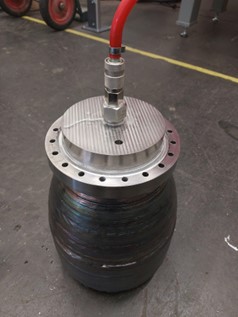
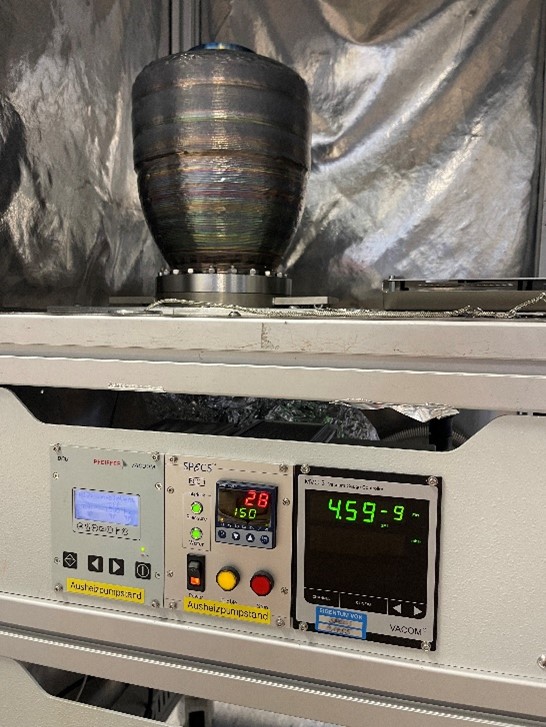
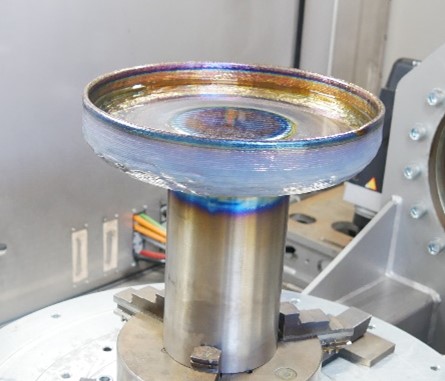
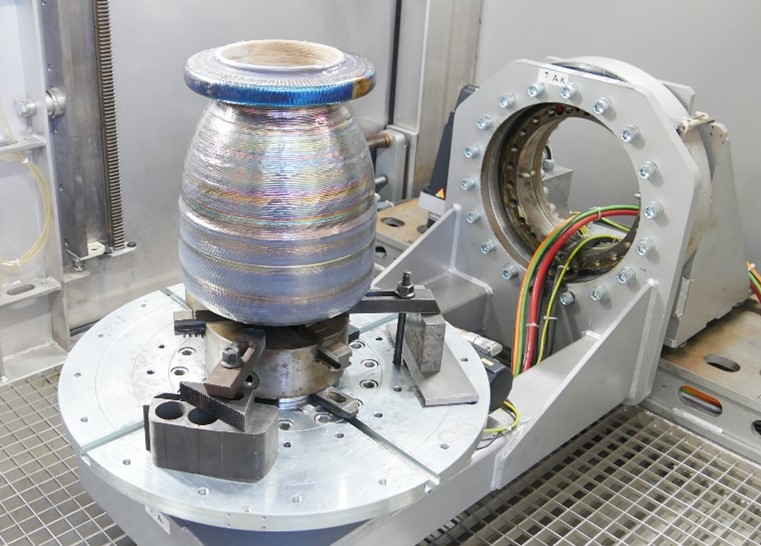
Pictures: Plasma metal Deposition manufacturing process of Ti6Al4V vessel; tested under vacuum and pressure.
Photos credit: RHp-Technology GmbH and Specs GmbH.