

ESA Spark Funding Programme has played a pivotal role in supporting the transfer of Airbus’ cutting-edge space technology to terrestrial use, that filters and extracts carbon dioxide from the air, using it in a variety of ways.
Climate Change and Technological Solutions
In the recent years, climate change has drastically increased, and its consequences can no longer be overlooked. Heatwaves, droughts and floods, the melting of glacial ice and the rising sea levels are omnipresent images, witnessed around the globe.
Triggered by the high concentration of carbon dioxide (C02) in the air, climate change presents a real threat to the Earth’s atmospheric barrier, making it permeable. To counteract this, companies from a wide range of sectors have set themselves the goal of “net zero” CO2 emissions.
Airbus Operations for instance, has developed a technology that actively removes the greenhouse gas from the atmosphere, enabling to re-use the gas to offset unavoidable emissions in industries such as transportation, energy generation and agriculture.
From Space to Earth: CO2 Filtration Technology
Airbus initially developed the technology to filter CO2 from the air for use on the International Space Station (ISS) as part of the life support system for the astronauts on board. The module reduces the CO2 content of the air in the space station and thus enables the crew to be effectively supplied with oxygen. Airbus used this module as the basis for a system that can also be used to efficiently remove carbon dioxide from the air in terrestrial applications.
To enable this transfer process from space to terrestrial applications, the adaptation and further development was supported by ESA Spark Funding Programme, which was initiated by the German ESA technology broker EurA. Subsequently, this highly innovative and outstanding future technology for climate protection was nominated for the Future Prize 2023.
The technology works as follows:
In the Direct Air Capture module, carbon dioxide is separated from the air in stages. First, a fan draws in air, which then flows through a filter. This consists of a solid material based on an amine – a chemical compound containing nitrogen. When this filter material is saturated with CO2 adsorbed from the air, the second process step follows: the adsorber cassettes are heated, and the carbon dioxide absorbed in them escapes again. The gas is collected in concentrated form and can then be used in various ways, processed further or stored permanently.
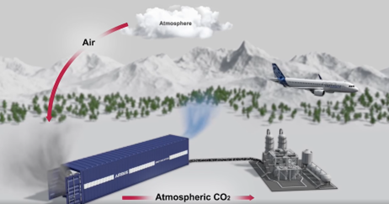
Source: Direct Air Capture Module. Credits: Airbus Operations
For example, it could be used as a raw material for industrial production processes. In the chemical industry, for example, CO2 is required in large quantities to produce various carbon-containing substances. Until now, the CO2 used for this has come from the combustion of natural gas or oil. With the technology of capturing the gas directly from the air, however, a closed cycle can be created in which the gas is recycled many times over, and does not end up as a climate-damaging emission into the atmosphere.