


The present invention relates to a novel feed system architecture that provides enhanced performance and/or reduced complexity compared to state-of-the-art solutions of interest in Very and Ultra High Throughput Satellite (V/UHTS) systems.. Combined with a standard reflector, the resulting antenna system is capable of generating a transmit/receive multiple beam coverage with frequency and polarisation reuse having a single reflector aperture and a single feed system.ESA is looking for partners who would be interested in getting a license and implementing this patent.
Description:
Broadband satcom payloads have pushed the development of Ka-band antenna systems to provide always more beams with less reflectors. A typical single-feed-per-beam antenna geometry requires 3 to 4 large apertures to produce a complete transmit/receive coverage of congruent beams. The number of apertures may be reduced using a multiple-feed-per-beam (MFB) feed system. In this sense, several solutions can be found in the literature based on single band feed systems with overlapping clusters combining from 6 up to 25 feeds. However, these solutions present some drawbacks e.g. they require two antennas to produce a complete multiple beam coverage, frequency selective sub-reflectors, etc.
The present invention introduces a number of improvements and when combined, the resulting feed system outperforms the state-of-the-art solutions
Two options have been considered: one based on a three-feed-per-beam solution and one based on a four-feed-per-beam solution. The solution with 3 feeds enables to increase notably the beam density when compared to existing dual-band feed systems using a single reflector antenna. A preliminary assessment has demonstrated the number of beams may be increased by about 50% at iso reflector geometry and service area. Alternatively, the invention may also be applied to a four-feed-per-beam feed system.
The key innovative steps compared to state-of-the-art solutions include:
• The combination of different feed clusters in the overlapping scheme obtained either by rotation or mirroring (reference solutions assume feed clusters are obtained by translation only);
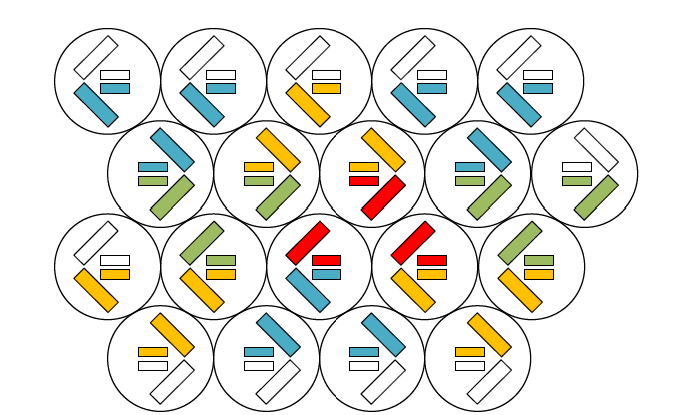
• A feed design with “pairs” of Tx/Rx ports diametrically opposed, enabling to rotate the feeds 180 degrees between adjacent lines (reference solutions assume all feeds arranged the same way).
The first aspect is illustrated in Fig. 1 for the case of a 3-feed cluster and a 4-feed cluster. Clusters operating in the same polarization are by pairs, yellow with blue and red with green. The proposed arrangements are such that each feed is only shared between two clusters of orthogonal polarization, e.g. yellow with red and green or blue with red and green. Concerning the second aspect, and using the port layout of the compact feed system ESA-PAT-782, the proposed arrangement meant to facilitate the BFN design is illustrated in Fig. 2. This particular arrangement enables to put ports operating in a same polarization and part of a same cluster next to each other, thus avoiding overlap between BFN designs. This greatly simplifies the waveguide routing and leads to a very compact solution, with well integrated Tx and Rx BFNs.

Innovations and advantages:
- The proposed solution may be implemented in different configurations, either simplifying state-of-the-art solutions and providing higher throughput density over the service area, or enhancing RF performance.
- The simplicity of the invention enables a very compact implementation and reduced design effort while maintaining high system performance.
Domain of application:
The concept has been developed for SATCOM applications, specifically for HTS/VTS system and could have major impact on satcom payload designs, either as main payload in passive antenna systems or as secondary payloads.
It also may benefit multiple beam radar systems for earth observation.
IP Status
An International patent application (PCT) has been filed.