

Around 500 participants from across the global space community gathered in Copenhagen in early September for Space for Inspiration, organised by the ESA Business in Space Growth Network (BSGN) and ESA Business Incubation Centre (BIC) Denmark under the theme “Scaling Research and Production in Space”. Over two days, ESA BIC entrepreneurs and managers from across Europe showcased how the next generation of commercial space is being built and discussed the opportunities and the barriers for innovation in Europe.
A royal opening sends a signal
Space for Inspiration opened at Bella Centre Copenhagen in the presence of Danish Royalty, with remarks from His Majesty King Frederik X alongside ESA astronaut Andreas Mogensen, the ESA Director of Human and Robotic Exploration, Daniel Neuenschwander, and the Danish Minister for Higher Education and Science, Christina Egelund.
The presence of Royalty clearly states the space economy’s role in society: space is no longer a distant ambition. It is a market being built now, and Europe has a genuine stake in how it scales.
Two ESA BIC Denmark companies, ERLEtek and Danish Graphene ApS, had the particular honour of presenting to His Majesty King Frederik X how their technologies and business cases contribute to the fast-growing space economy.
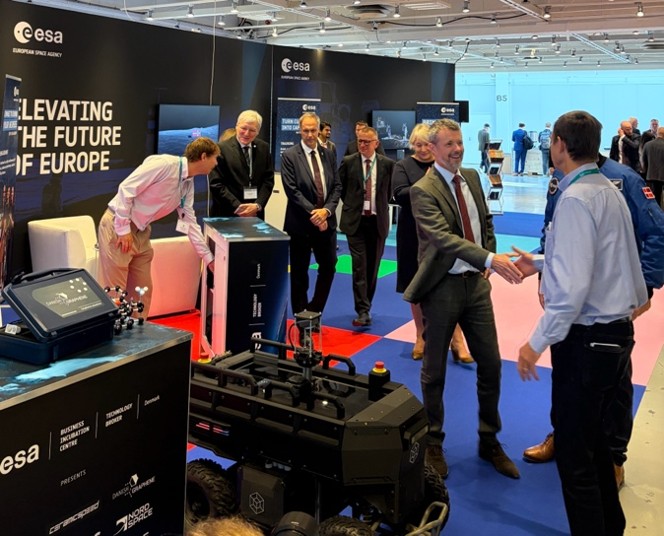
Ahead of the opening ceremony, His Majesty King Frederik X visited the ESA booth for an introduction to ESA BIC success cases.
Building businesses on Earth and beyond
ERLEtek, which grew out of work at the Technical University of Denmark (DTU), builds autonomous mobile 3D concrete printers that operate in coordinated swarms, solving on-site construction problems on Earth today while developing the autonomy that off-Earth construction with moon regolith will demand in the future.
Danish Graphene solved the problem that has kept graphene a laboratory material: producing it consistently, sustainably and at an industrial scale. Space turned out to be the proving ground: once the material demonstrated it could hold up under the hard conditions of space, terrestrial industries took notice, and demand followed on Earth.
The two companies that presented to His Majesty illustrate the same point: how developing technology for space can accelerate business on Earth. In both cases, the demands of space pushed the engineering further than a terrestrial market would have required, and the results are already creating value here on the ground.
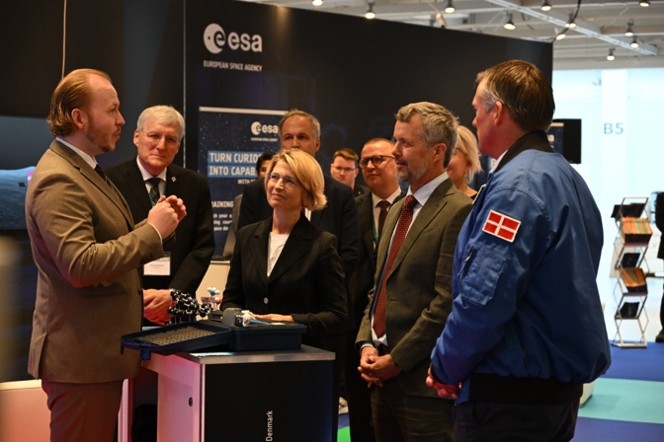
Danish Graphene, ESA BIC DK Alumni, presenting to His Majesty King Frederik X during the opening session.
Every company should look into space when doing their SWOT analysis
The examples from ERLEtek and Danish Graphene point to the same conclusion: space is becoming a strategic success factor for companies across a wide range of industries. That was precisely the point Sune Nordentoft Lauritsen, Managing Director of Space Ventures Denmark, which manages ESA BIC Denmark, made on stage when discussing the objectives for the conference.
“Every company scans the horizon when it does a SWOT analysis, but scanning the horizon is no longer enough. You have to look up — to space. Space is already reshaping health, materials, agrifood, energy and many other industries, and it belongs in your company’s list of threats and opportunities whether you’ve noticed or not. These two days are about getting European entrepreneurs, companies and researchers to look up, and to find the people who can help them act on what they see,” said Sune Nordentoft Lauritsen.
His argument rests on timing. The commercial space economy has been building for years, but the technology and the cost base are only now starting to reach a point where activities that used to be unthinkable could become feasible, and the next five to ten years are when the domain really opens up. Energy harvesting, microgravity production and lunar construction were all on the conference programme; five years ago, none of them would have been a serious business conversation.
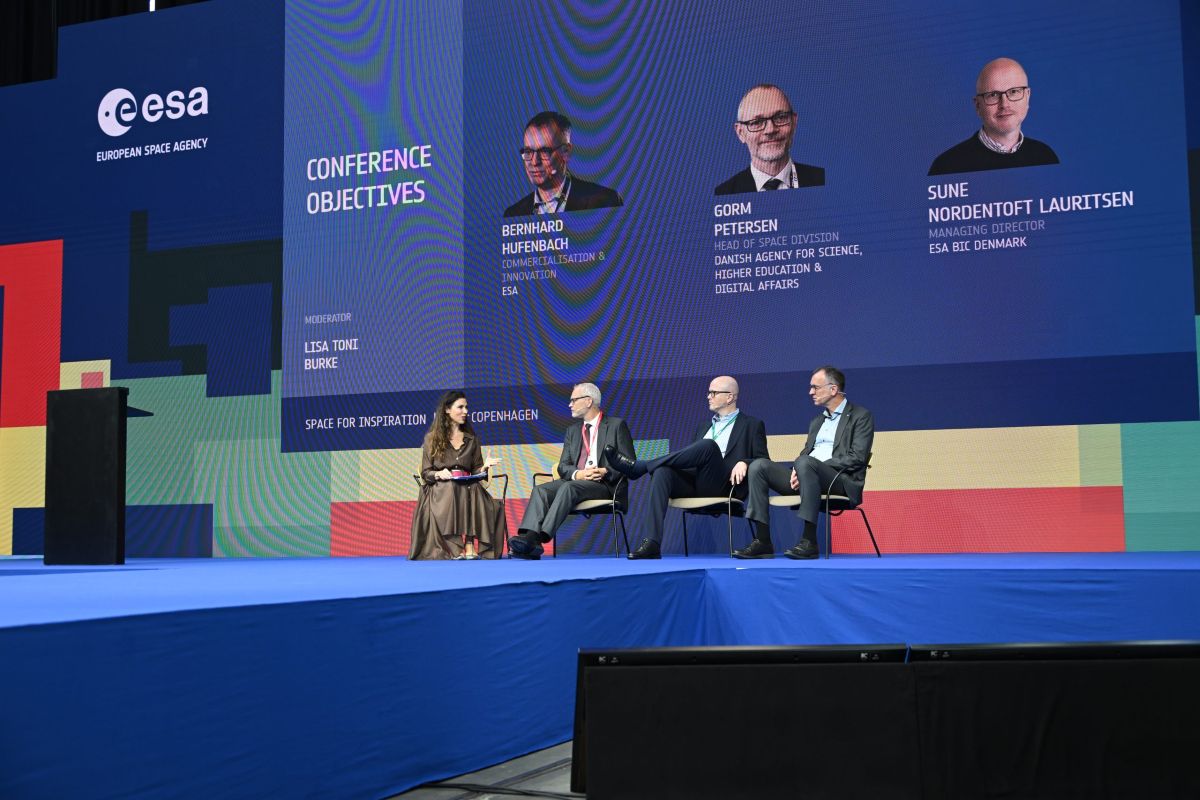
Sune Nordentoft Lauritsen, Managing Director of Space Ventures Denmark, which manages ESA BIC Denmark, discussing conference objectives on stage with Bernhard Hufenbach, Commercialisation and Innovation at ESA, and Gorm Petersen, Head of Space Division at the Danish Agency for Science, Higher Education and Digital Affairs. Moderated by Lisa Burke.
Paving the way for ambitious entrepreneurs
If space is an arena for innovation, the question that follows is what it actually takes to build something there and whether Europe is creating the conditions for its most ambitious projects to become feasible.
Stefan Gustafsson, Commercialisation Officer at ESA and manager of activities in the Nordic region, gave a keynote on disruptive innovation and how fertile ground for ambitious innovation projects can be created across Europe.
“If you look at disruptors in terrestrial markets, like the personal computer, the mobile phone, or low-cost airlines, then none of them won by having the best technology. They began in an underserved market. That is the pattern: low margins, high volumes, technology as the enabler rather than the product,” said Stefan Gustafsson.
He drew the parallel to space directly. About a decade ago, Europe concluded that reusable launchers were not a viable approach. Both the US and China have since demonstrated that they can land a booster, and Gustafsson puts the European conclusion down to a lack of vision.
“In Europe, the discussion is now mostly about European sovereignty and access to space, and about catching up where others are ahead of us. This is not sufficient to give us a large commercial footprint in the space market. To make this happen, we need an ambitious long-term vision that helps us bundle and focus our efforts towards a common goal, backed up by significant funding,” said Stefan Gustafsson.
Without that vision, he argued, the cost is not only a smaller commercial footprint. It is felt across the ecosystem, and ultimately in where entrepreneurs choose to build.
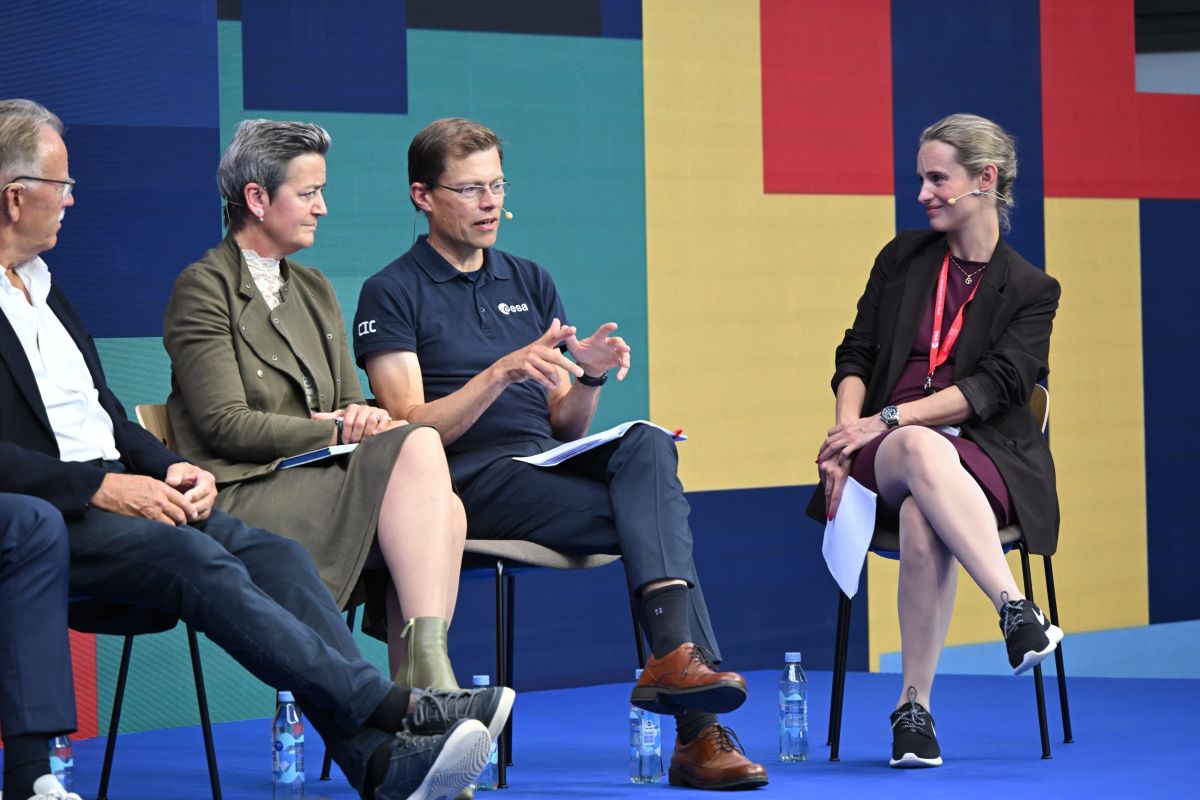
A panel is discussing how to create fertile ground for disruptive innovation in Europe. From the left: John Leif Jørgensen, Professor at DTU Space; Margrethe Vestager, Former EU Commissioner; Stefan Gustafsson, Commercialisation Officer at ESA; and moderator Kathrine Boysen, ESA BIC Denmark.
“In Europe, we are very good at incremental development of advanced technology as a way of reducing risks, but this only brings us one or two steps further. The lack of an ambitious long-term vision also means that the whole ecosystem suffers. Few actors are prepared to take bigger risks and stay in the business for a longer time. As a result, many startups choose to leave Europe. We often blame the lack of funding, and while we cannot do things without money, the lack of a vision may be an equally important reason for why entrepreneurs choose to have their future elsewhere. For example, a large European space station, opening up for a global market of in-space experiments and production, could be a vision that makes entrepreneurs believe in a future for their companies in Europe.” said Stefan Gustafsson.
How creating access to space could help us find the cure for cancer
One of the potential disruptive cases highlighted on stage was SPARK Microgravity, an ESA BIC alumni from ESA BIC Bavaria. Founded in Munich in 2024, SPARK is building Europe’s first orbital laboratory dedicated to finding the cure for cancer in space.
Their solution is an autonomous lab the size of a milk carton designed for pharma companies to study cancer tumours in microgravity. The lab is designed to run without an astronaut on board at roughly a tenth of the cost per experiment of systems that require human intervention in orbit. What makes it a disruption story rather than a research story is the commercial model. The first buyers are pharmaceutical R&D teams; the longer-term ambition is an affordable subscription service open to any oncologist. If it works, microgravity research shifts from an agency-funded curiosity to a pharma industry-bought service — precisely the move from underserved market to volume market that Stefan Gustafsson described from the same stage.
Impact across the ESA Commercialisation Network
Space for Inspiration also brought together representatives from across the wider ESA Commercialisation Network: ESA BIC managers, technology brokers and commercialisation staff from across Europe. For the network itself, much of the value of the two days lay in the relationships built.
“For me, the Space for Inspiration conference was highly valuable. I would especially highlight the opportunity to maintain and strengthen my network across Europe’s commercial space community, and to gain a deeper understanding of — and inspiration from — how space technologies can be applied across a wide range of contexts. The Nordic space ecosystem is growing rapidly, and the conference provided a valuable forum to reinforce existing collaborations, establish new ones, and connect with the wider European community, including technical specialists,” said Jo Bjørnstad, Head of Space & Manager ESA BIC Norway.
In addition, the impact of the ESA BSGN Industry Accelerators was visible throughout the event. Representatives from MEDES, the Satellite Applications Catapult, STAM & SCM Europe, and ESRIC, which lead the network’s Health & Life Sciences, Advanced Materials & In-Space Manufacturing, Agri-Food, and Space Resources accelerators respectively, led dedicated sessions and workshops that brought together entrepreneurs, researchers, investors and industry leaders around commercially driven opportunities in space. They also coordinated the Academic Challenge, helping identify promising early-stage concepts with strong commercial potential and connecting them with the expertise, networks and support needed to accelerate their path toward market adoption. Through these activities, the accelerators demonstrated how the ESA Commercialisation Network not only builds connections, but actively helps transform innovative ideas into future businesses.
Commercialising space will take more than technology. The connections that turn it into a business have to be made, and that is what the ESA Commercialisation Network is for, and what Space for Inspiration helped to do.
Discover more on ESA space commercialisation ecosystem
Further information on ESA space commercialisation ecosystem are available at the following links: