

Workplace safety is a top priority, especially for individuals operating manually guided pallet trucks, where the risk of serious injury remains high. In 2022 alone, the German Social Accident Insurance (DGUV) recorded 3,304 reportable accidents involving such equipment. Many of these incidents were severe enough to result in long-term disability pensions.
In response to these figures and the lack of reliable safety systems, BASF and the German Social Accident Insurance Institution for the Trade and Goods Logistics Sector (BGHW) joined forces with partners from industry and space technology to develop an innovative safety solution.
Supported by the ESA Spark Funding Initiative, the project led to the creation of a highly sensitive optical sensor system designed to protect logistics personnel. Originally developed for use in space robotics, the fiber-optic sensor system (FOS) is deployed on the International Space Station (ISS). It plays a key role in the Canadarm2 robotic arm, helping detect potential collisions with other components or astronauts.

Canadarm2 robotic arm (CREDIT: NASA – LICENCE: ESA Standard Licence)
Kinotex Sensor GmbH is dedicated to bringing this advanced technology into everyday use—extending its applications beyond space to industrial, medical, and automotive fields. The Kinotex system addresses a core challenge in tactile sensing. It is a robust, flexible fiber-optic sensor that mimics the sensation of human touch. Like artificial skin, it can cover entire robotic surfaces and provide essential feedback. Its functionality is based on a specially structured foam layer that changes light scattering even with minimal contact, enabling extremely sensitive touch detection.
This space-derived technology has now been adapted to meet the safety requirements of industrial environments. When integrated into the lower area of a pallet truck, the system detects even the slightest contact with a foot or leg. In such cases, it triggers an automatic stop—effectively preventing injuries. Development is led by Kinotex Sensor GmbH, in close cooperation with BGHW, BASF, Contemps GmbH, Suffel Fördertechnik (integration partner for Linde equipment), and Linde Material Handling.
EurA AG, acting as Technology Broker Germany, supports the project by facilitating collaboration, providing funding, and guiding the path from concept to market. Their role ensures smooth knowledge transfer between research and industry, helping bring the solution to widespread application.
The sensor system is being commercialised as a modular solution with integrated signal processing. It can be installed in both new and existing vehicles by various manufacturers and service providers.
“Our goal is to make advanced space technology an invisible yet indispensable part of everyday industrial safety. Kinotex protects operators—without slowing them down,” says Winfried Bindges, CEO at Kinotex Sensor GmbH.
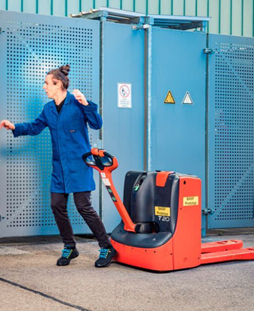
High risk of injury when operating manually guided pallet trucks (CREDIT: Kinotex Sensor GmbH)
The system was presented to a wide audience of professionals at the BGHW exhibition booth during LogiMAT 2025. Its effectiveness impressed many, and several large retail and industrial companies—including BASF, Unilever, Procter & Gamble, EDEKA, Lidl, and REWE—are already planning pilot tests in their central warehouses.
Looking ahead, the sensor system is expected to be used in other safety-critical areas, such as forklifts, collaborative robots, or seat occupancy detection systems. With its continuous self-monitoring, the system meets high safety standards and is built for broad industrial use.
Thanks to the support of the European Space Agency and the coordination by EurA AG, this cutting-edge technology is now helping make workplaces around the world safer—from space missions to everyday logistics.
Discover more on the ESA Technology Brokers