ESA title

CONTACT US

Learning Hub The ESA Learning Hub is a web-based platform which provides access to training courses and materials linked to ESA programs and initiatives

Matchmaking ESA-Match is a platform that lets companies showcase their competences and capabilities, find partners, explore commercial opportunities and establish business relationships

Intellectual Property ESA makes its intellectual property available to European space companies within its 22 Member States, on a freely-licensed basis

ESA Patents

CONTACT US

    * Mandatory field

    PATENT CATEGORY

    REFERENCE #

    552


    PATENT COMPETENCE DOMAIN

    ABSTRACT

    The European Space Agency offers a sequential switching shunt regulator cell including a shunting switch with driving means. A non-redundant rectifier is disconnecting the power bus from the shunting switch if closed. A fault detector is included to detect short-circuit conditions and to open the shunting switch in such a case. The technology owner is looking for partners for a licence agreement and for industrialising the technology.

    Description of the offer

    The invention relates to an improved sequential switching shunt regulator cell, and to a solar power regulator comprising a plurality of said cells.

    In many applications it is essential to ensure that a single failure cannot result in a significant loss of operation. A short-circuit of the diode of a single sequential switching shunt (S3R) sequential switching shunt series regulator (S4R) cell would result in a total loss of operation. Therefore, two diodes connected in series are generally used, but unfortunately, reduces the power efficiency of the system. The increase in power dissipation hinders miniaturisation of the regulator and requires bulky and heavy heat sinks. The offered technology aims at avoiding this major drawback by providing a sequential switching shunt regulator cell comprising a power line connecting a power source to a power bus including a shunting switch with driving means. The cell furthermore comprises a non-redundant rectifier connected in series to the power line for disconnecting the power bus from the shunting switch if closed. A fault detector is included to detect short-circuit conditions in the non-redundant rectifier and to open the shunting switch in such a case.

    Innovations and advantages of the offer:

    The offered technology:

    • Provides several different embodiments of the fault detector, which is able to monitor the voltage levels of the power line and driving means in order to detect a short-circuit fault.
    • Obtains an ever greater increase in power efficiency by the use of a synchronous rectifier which replaces the diode.
    • Solved the difficulty to distinguish between a failure condition and a transient which can occur in nominal operation by providing a solution based on the observation that it is not necessary to activate the fault detector within a single cycle of the shunting switch.

    Considering a typical power system comprises several cells, and several generators, the efficiency gain provided by the offered technology can be quite substantial.

    Domain of Application:

    Although S3R (S4R) regulators are widely spread in the space sector for solar cells and arrays in satellites, the offered technology may also be applied, among others, to power supplies in the automotive sector and the terrestrial solar energy sector.

    • Power Supplies
    • Solar Energy
    • Photovoltaic Solar
    • Other Energy

    Energy Management

    PATENT CATEGORY

    REFERENCE #

    550


    PATENT COMPETENCE DOMAIN

    ABSTRACT

    The European Space Agency (ESA) developed a solar power system including an innovative regulator. Such regulator improves the power conversion between the solar array and the battery. This invention has an increased efficiency over previous offerings, leading cheaper power systems that dissipate less energy. It also allows more flexibility in the design of the solar arrays, as the technology can accommodate for different configurations without the need to redesign the whole regulator. License agreements are sought.

    Description of the offer:

    This solar array regulator (SAR) is based on a step-up and step-down converter. The control loop of the boost power cell is highly stable, the control system ensures smooth transition between different operation modes (step-up, step-down, Direct Energy Transfer, DET) and it is stable in all operation modes, e.g. In battery management mode, but also when operating on the voltage and current region of the solar array in MPPT (Maximum Power Point Tracking) mode, in the event of a failure, simultaneous operation of the step-up and step-down cells is avoided, the complexity of the system is low, particularly in case of analog implementation.

    Innovations and advantages:

    With this invention you will get next benefits:

    • Increase the efficiency of the solar array, with less cost and less dissipation.
    • Increase the flexibility of Solar array design
    • As this inventions applies to any configuration, it would be recurrent, what means less cost. 

    Commercialisation aspects:

    Applications and Markets

    The main applications are in solar power generation stations, off-shore or remote facilities or equipments powered by solar energy. It can also be applied to DC-DC converters when the input offers instability such as in power grids, batteries, buildings, electric vehicles, etc.

    Intellectual property status

    Currently patented and looking for license agreements.

    PATENT CATEGORY

    REFERENCE #

    565


    PATENT COMPETENCE DOMAIN

    ABSTRACT

    ESA has developed a technology that relates to a monolithically integrated package containing both a radio-frequency power amplifier and envelope tracker which are for use in space telecommunications and/or cellular networks. This new technology offers better efficiency, wider bandwidth, better integration, better linearity and power flexibility. A license agreement is sought.

    Description

    Improving the efficiency, consumption, dissipation and/or linearity of radio-frequency (RF) solid state power amplifiers (SSPAs) is a high priority for manufacturers of ground mobile telephony network infrastructures due to the very demanding requirements for 3G-UMTS.  The very high linearity required dramatically impacts the efficiency of power amplifiers used in base stations.  Similar requirements arise in in space applications.

    Linearity and energetic efficiency are seen as contradictory requirements and therefore the “flexible amplifier” concept consists in adjusting the power supply to the average RF power in order to achieve both high linearity and high efficiency.  “Envelope tracking” is an evolution of this approach, wherein the power supply is dynamically adjusted, following the RF signal envelope.

    The invention solves the problems of existing SoA through a device consisting of a radio-frequency power amplifier with envelope tracking, comprising:

    • A power RF amplifying device
    • A fast DC/DC converter for envelope tracking using two RF power transistors for implementing both the switching element and rectifier.
    • An optional low-pass filter for reducing the bandwidth of the envelope signal on which the PWM signal driving the DC/DC converter depends.

    As an advantage, the switching device, the rectifying device and the power RF amplifier can be identical transistors.

    An RF power transistor connected as a rectifier enables a high commutation speed to be achieved, whilst dealing with comparatively high currents (>1A) and powers (several Watts).  This is not possible using commercial diodes and therefore a transistor connected as a two terminal device avoids “diode bottlenecks” seen with current technology.

    Innovations and advantages

    The technology offers better efficiency, wider bandwidth, better integration, better linearity and power flexibility. Monolithic integration of the envelope tracking circuit and the main RF power amplifier is possible. A single power supply to the envelope tracking circuit is sufficient.

    Commercialisation aspects

    Applications and Markets

    This power amplifier may be used in any field where a modulated signal (most efficient case) is used. 

    Examples include:

    • General telecom applications (L, S, C band) such as telephony, radio, TV or radio links
    • GNSS communications
    • Ground applications that use an SSPA transmitting device (e.g. SAR imaging)
    • Radar
    • Sensors (ultrasonic, infrared or laser) which use a modulated signal for increasing their range.
    PATENT CATEGORY

    REFERENCE #

    645


    PATENT COMPETENCE DOMAIN

    ABSTRACT

    This invention relates to a LVDS receiver capable of detecting link failure, be it a single short failure, double short failure, single open failure, or double open failure. The invention proposes a method of determining this link failure in 3 steps using a peak detector, which is more noise resilient and a comparator only, instead of the common 3 comparators used in other market products. Moreover, the proposed solution is also characterized by providing a simplified and more compact design, with reduced overall costs and improved system reliability.

    Description

    The fail-safe circuit presented here assesses the quality of the signal or potential link failure modes and provides a signal quality flag to take appropriate decisions when processing the received data. This is done with integrated circuits that monitor and measure incoming signal levels, amplitude, strength and impedances and then perform the appropriate control actions over the incoming and outgoing signals. The latter can range from blocking the incoming data stream to for example switching to the redundant communication link or enabling higher communication level protocol error detection and correction schemes. The link failures that can be detected with the proposed fail-safe circuits are: 

    a) single short failure: one input line short circuited to a fixed voltage

    b) double short failure: both input lines are short circuited to a fixed voltage

    c) single open failure: one input line has an broken connection (is disconnected). Both small and high capacitive loads at the input of the LVDS receiver are cases where the open failure should be detected.

    d) double open failure: both input lines are disconnected, due to either a cable rupture between transmitter and receiver or due to the receiver line being connected to a switched-off transmitter, which is  operating in cold redundancy.

    Innovations and advantages:

    The techniques commonly used in LVDS receivers are known to induce noise and self-oscillations to the data transmission that corrupt it and, for some applications, these are crucial factors. In order to minimize this effect and provide link failure detection, this invention proposes a new approach characterized by: 

    • Using a peak detector which is more noise resilient than the window comparator, used in other solutions.
    • Only 1 comparator is needed instead of 3.
    • Simplified design due to using fewer components and not requiring external hardware.
    • Reduced dimensions and materials used.
    • Reduced manufacturing costs.
    • Improved reliability of the overall system.

    Commercialisation aspects

    Applications and Markets

    This invention is useful for any application that uses LVDS, such as any electronic system that requires the communication between different parts (peripherals and a processor).

    • Machine vision. This invention could be used to improve the signals received by machines to their vision systems, thus improving their perception of the environment and their autonomy.
    • Other peripherals. Asides from vision and display peripherals, LVDSs are also used for interconnecting the processing unit to other peripherals, such as memory units. It could present strong benefits for applications on super-computers.
    • Bio-medicine. Applications (such as DNA micro-array analysis, mass spectrometry and confocal microscopy, among others) where the data gathered is highly sensitive to noise, be it because of the low values or the precision required.


    Intellectual property status

    An international patent application has been filed.

    PATENT CATEGORY

    REFERENCE #

    754


    PATENT COMPETENCE DOMAIN

    ABSTRACT

    The invention concerns the field of electrical power supply, including AC/AC, AC/DC, DC/AC and DC/DC power switching converters. It is a closed-loop control concept, primarily relevant to current regulation but also to voltage regulation. It allows to reach the maximum bandwidth frequency, at given switching frequency. In turn power supply products can have better dynamic performances, hence lower mass and cost.ESA is looking for partners who would be interested in licensing and implementing this patent.

    Description

    The present invention consists in extending average current mode control with symmetrical sawtooth beyond its limit to reach peak current mode control “with symmetrical compensation ramp”. The symmetrical compensation ramp necessary to implement such peak current mode control shall consist in two asymmetrical compensation ramps. This is the essence of the invention, as illustrated on the figure below.

    Symmetrical sawtooth extended to double compensation ramp
    Symmetrical sawtooth extended to double compensation ramp

    By substituting the upper (in blue) and lower (in violet) compensation ramps to the symmetrical sawtooth (dotted line) relevant to symmetrical Average Current Mode control, the current waveform is allowed to move from low gain (in green) to higher, optimal, gain (in red) relevant to Peak and valley Current Mode control.

    Innovations and advantages:

    As yet, current mode control would resort to average control with asymmetrical sawtooth, or peak control with asymmetrical compensation ramp or average control with symmetrical sawtooth. Considering that average current control (with negligible integral loop gain) is a subset of peak current control, the missing link was peak current control with symmetrical compensation ramp. It constitutes the ultimate control strategy because peak current control has superior dynamics with respect to average current control and because symmetrical sawtooth or compensation ramp offers a factor 2 on the bandwidth performance with respect to asymmetrical sawtooth or compensation ramp. In turn, power supply products can have implemented with reduced mass and cost.

    Domain of application:

    The scope of applications of the invention is quite extensive as it concerns not only DC/DC power supplies for space, but also AC/DC, DC/AC and AC/AC power supplies for terrestrial (50 Hz) or aeronautical (400 Hz) applications.

    PATENT CATEGORY

    REFERENCE #

    768


    PATENT COMPETENCE DOMAIN

    ABSTRACT

    The invention is a catoptric telescope using an optical design based on freeform mirrors. This design allows to scan the line of sight by tilting one of the mirrors with optical power. This capability, when used on board of a low Earth orbit satellite, allows to keep the telescope pointed to the area of interest, an observation mode called ‘pointing and nodding’, or to partially compensate the satellite motion relative to the area of interest, an observation called ‘partial motion compensation’. Both these mode operations allow to increase the detector’s integration time, and therefore, to improve the signal-to-noise ratio of the acquired image. The invention is a product and the methodology of using it.ESA is looking for partners who would be interested in licensing and implementing this invention.

    Description:

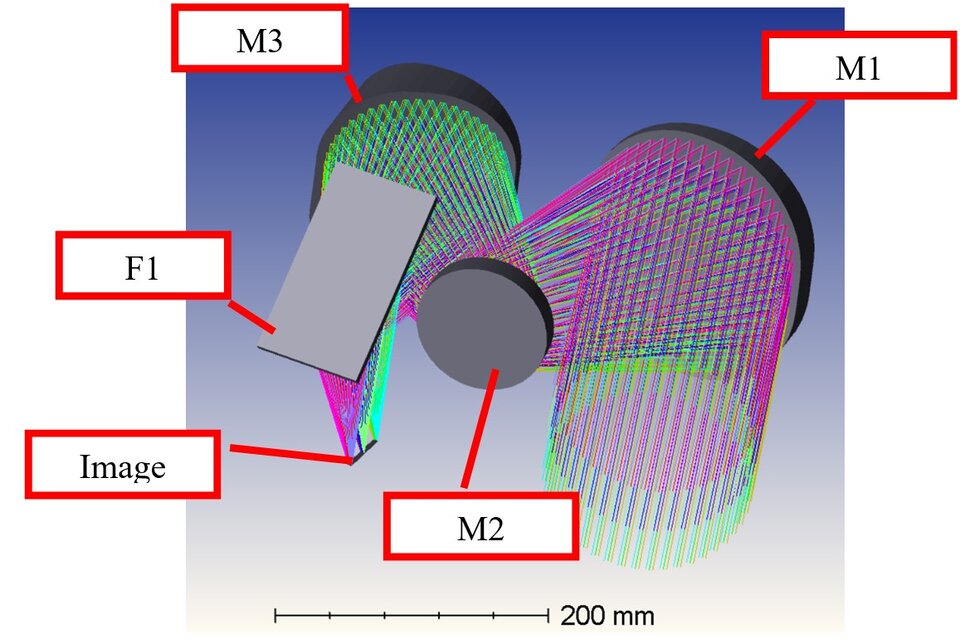
    The exemplary optical system is based on a Three-Mirror Anastigmat (TMA) design. The telescope has an aperture of 150 mm and an f-number of 2.5. The optical design of this embodiment of the invention is based on a TMA telescope using non-rotationally symmetrical mirrors, known as freeform mirrors (Figure below).

    Exemplary TMA design with tiltable M2 mirror
    Exemplary TMA design with tiltable M2 mirror

    This optical solution, which deviates from a standard TMA implementation, is tolerant to the tilt of the mirror M2, therefore the telescope line of sight can be changed by tilting M2. The spatial resolution of the instrument depends on the rotation of the Line of Sight (LoS). The best performance is reached at the nominal position of the M2 mirror with symmetric decrease to both sides with increasing rotation angle. The optical quality of the telescope is practically unaffected for changes of line of sight up to +/- 1 arcmin in the along track direction thanks to the use of free form mirrors. The tilt of M2 is obtained by mounting the mirror on a tilting mechanism that is commercially available.

    Innovations and advantages:

    By rotating the LoS by approximately +/- 1 arcmi an integration time up to 50 ms can be achieved, as the telescope LoS will be constantly pointed on the selected target. This gives fourfold increase of the Signal to Noise Ratio (SNR) with respect to the normal pushbroom observation for a 26 m Ground Segment Distance (GSD). Larger angles, i.e. +/- 2 arcmin, could be achieved with a modest degradation of the image quality, offering the flexibility to further improve the SNR at the expensed of ground resolution. 

    The pointing and nodding operation being achieved by rotating one of the powered telescope mirrors, there is no need of an external scanning mechanism. This reduces the mass and complexity of the telescope.

    Domain of application:

    Remote sensing, spectrometry.

    Keep updated on all ESA opportunities

    Subscribe to our newsletter or visit our Help page for quick answers

    Subscribe to newsletter Get Help