

Jointly organised by the European Space Agency (ESA) and the French Space Agency Centre national d’études spatiales (CNES), the ActInSpace 2026 international finals took place on 2 April in Bordeaux, bringing together promising teams from this year’s global hackathon and highlighting ESA’s active role in evaluating and rewarding innovative uses of space technologies.
The Hackathon
This sixth edition began with the global hackathon on 30-31 January 2026, held simultaneously across all participating locations to ensure equal access to mentoring and remote expert support.
Across 23 countries and 53 cities, 1 621 participants organised into 391 teams worked through 27 challenges proposed by ESA, CNES, Airbus, Thales Alenia Space and several other partners.
The challenges are grouped into thematic areas to help guide participants in shaping their ideas:
- Everyday Life Business: using space technologies to develop solutions with direct societal or commercial impact.
- Be a NewSpace Player (#Space4.0): applying terrestrial technologies to improve space operations and contribute to the evolving NewSpace ecosystem.
- Space for Earth & Humanity: addressing humanitarian and environmental challenges through space‑enabled services.
- Fly to the Moon and Beyond: exploring ambitious concepts inspired by space exploration and future missions.
These themes encouraged participants to think creatively about how space technologies and data can be adapted to address challenges on Earth or support future developments in the space sector.
The International Finals
ESA was represented at the finals by three representatives:
- Franck Germes, Head of the Contracts Department at ESA
- Natacha Callens, ESA Academy Engagement Administrator
- Guillaume Prigent, Business Developer & Partnership Officer at ESA
They contributed to jury sessions, prize deliberations and engagements with participating teams, helping ensure that the evaluation process reflected both technical merit and potential for future development.
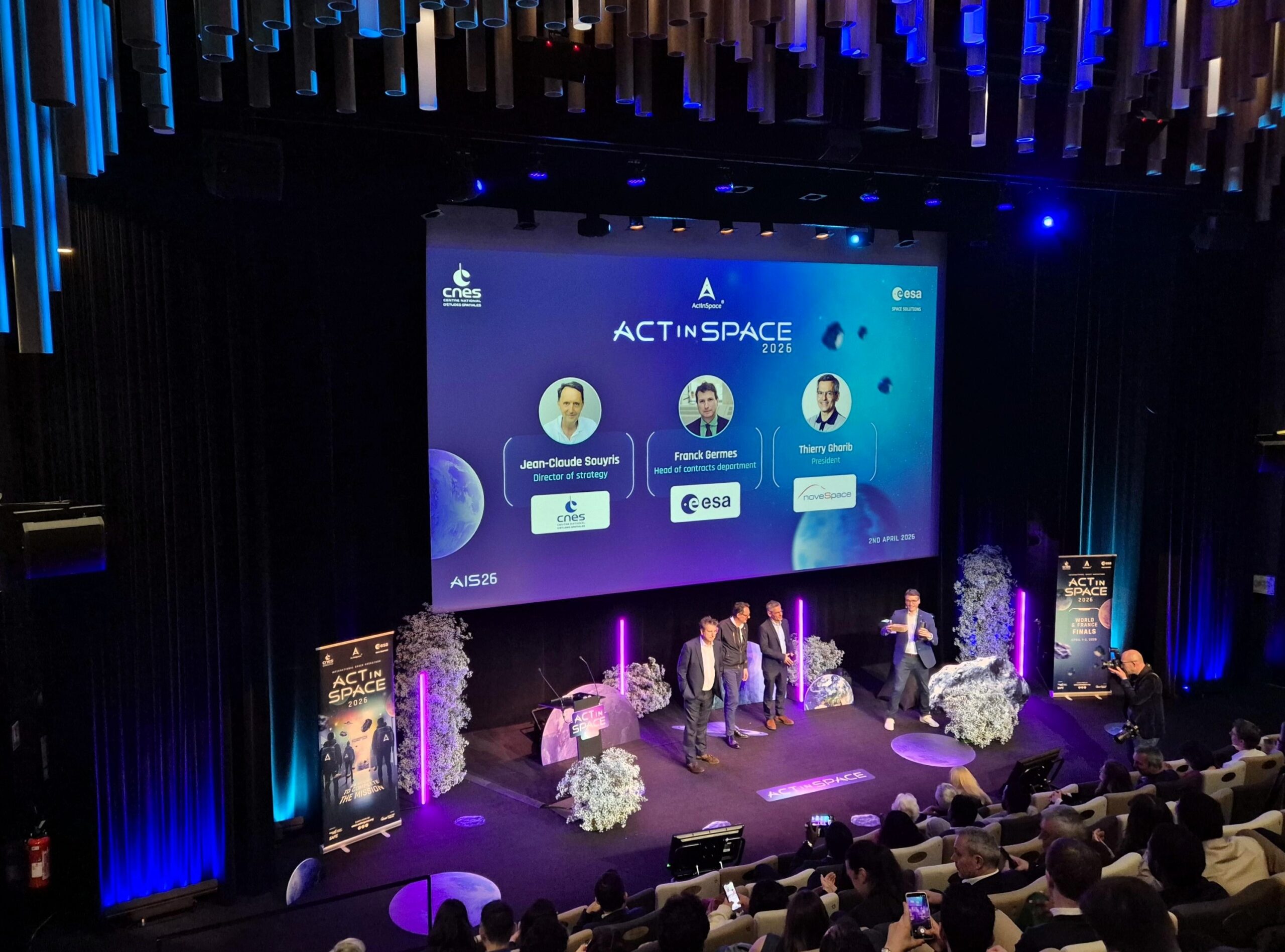
On stage (from left to right): Jean‑Claude Souyris, Director of Strategy at CNES, Franck Germes, Head of the Contracts Department at ESA, Thierry Gharib, President at Novespace
Recognition of the ESA Prize Winners
ESA awarded two prizes linked to its Earth observation (EO) and technology transfer challenges.
The EO prize recognised innovative uses of EO data and AI. The winning team IPSA-OB2S from Paris-Saclay, AgriTradeTwin project, a concept that showed strong technical potential and clear future applicability. As part of the prize, the team will be invited to present their work at the Φnnovation Summit at ESA‑ESRIN from 23-25 June 2026.

Guillaume Prigent, Business Developer & Partnership Officer at ESA, presents ESA-sponsored EO prize
The technology transfer prize highlighted the adaptation of space‑derived capabilities for new terrestrial applications. The winning team, Thunderwave team from Lithuania, was recognised for this prize. Up to five eligible team members will receive a place at an ESA Academy business‑ and innovation‑focused training session in 2026 or 2027.
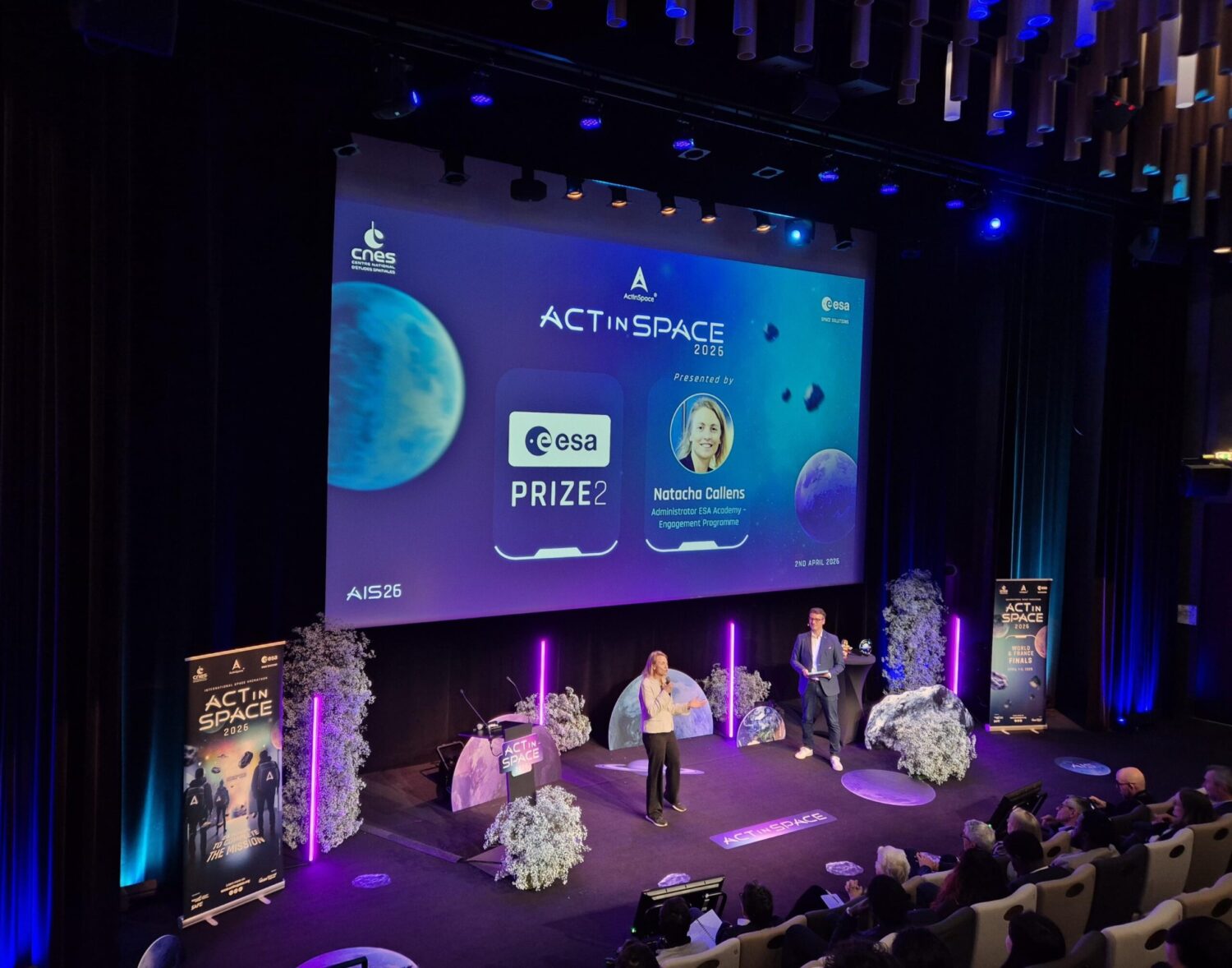
Natacha Callens, Administrator of ESA Academy Engagement Programme, presents ESA Academy-sponsored prize
Finals Results and Jury Deliberation
Five teams reached the international finals following the morning’s semi‑finals. They pitched their concepts before an international jury chaired by Jean‑Claude Souyris, Director of Strategy at CNES. After careful deliberation, the jury selected the overall winner of ActInSpace 2026, which will receive the event’s grand prize: a zero‑gravity flight aboard the Airbus A310 Zero‑G.
INTERSTELLAR, from Dakar American University of Science and Technology, was announced as the overall winner during the closing ceremony.
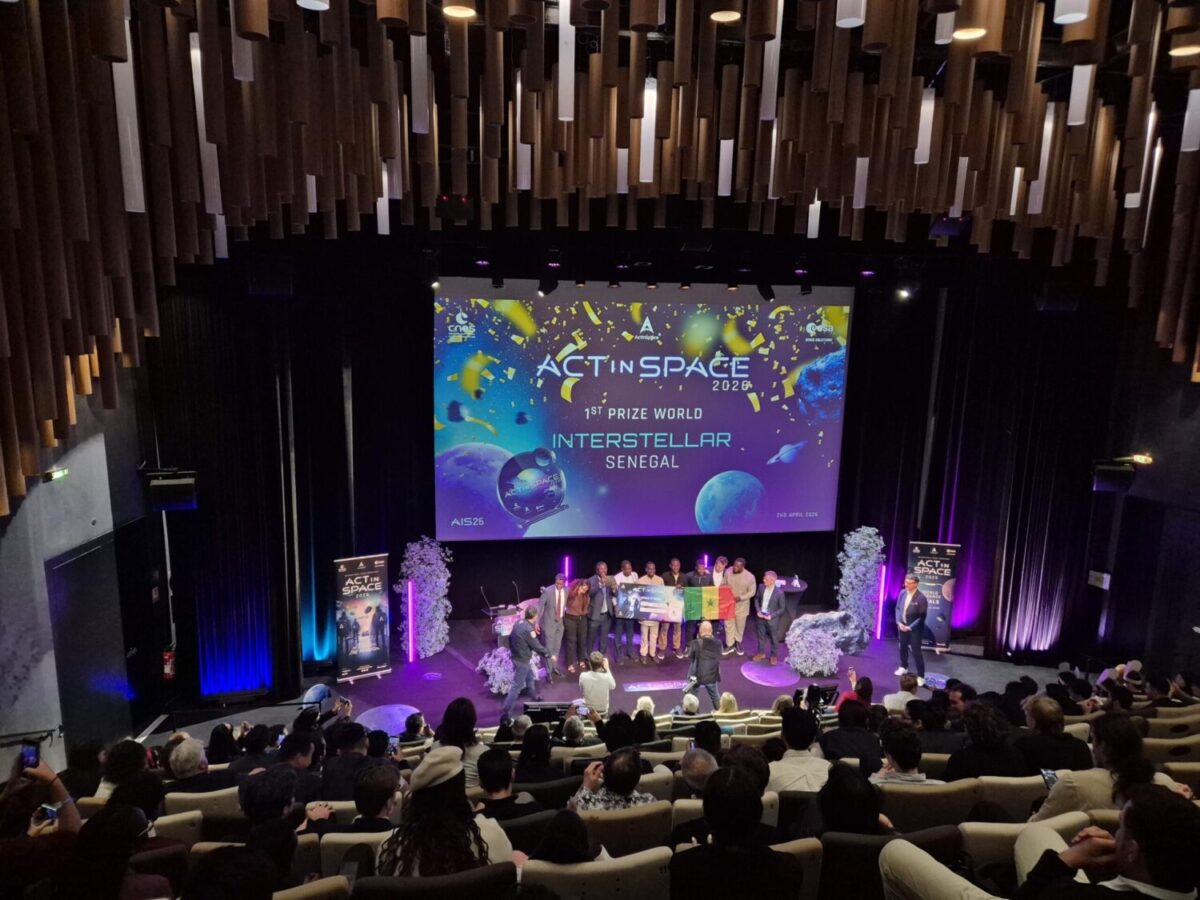
ActInSpace 2026 first prize winner, INTERSTELLAR, from Dakar American University of Science and Technology
Continuing a Global Innovation Effort
Since its creation in 2014, ActInSpace has grown steadily, encouraging teams to explore entrepreneurial pathways supported by technical and business‑oriented guidance. Companies born from earlier editions remain active today.
The 2026 event continued this dynamic, demonstrating the value of bringing together a diverse international community to address real‑world challenges using space technologies. By fostering a greater understanding and appreciation of space and its possibilities among future generations and the evolving workforce, the initiative encourages participants from different backgrounds to think creatively and approach challenges from new angles. This diversity of perspectives supports the development of innovative solutions that might not emerge in more conventional settings.
Download the hackathon report