

Space has long been integral to European society. Navigation, communication and observation systems have supported both civil and defence needs for decades – connecting communities, protecting infrastructure and enabling rapid response to crisis. This capability rests on space transportation: launcher technologies have always had a dual-use role, and space transportation supports in-orbit capabilities.
Today, that dual-use foundation is expanding. The geopolitical climate demands faster production, stronger coordination and the ability to adapt technologies across missions. Strengthening dual-use capabilities has become essential to Europe’s strategic autonomy.
FLPP, the European Space Agency’s programme for future space transportation, is central to this evolution. Every part of the programme – both the technology it supports and the methods it uses to pilot industry – supports Europe’s ability to act independently and together.
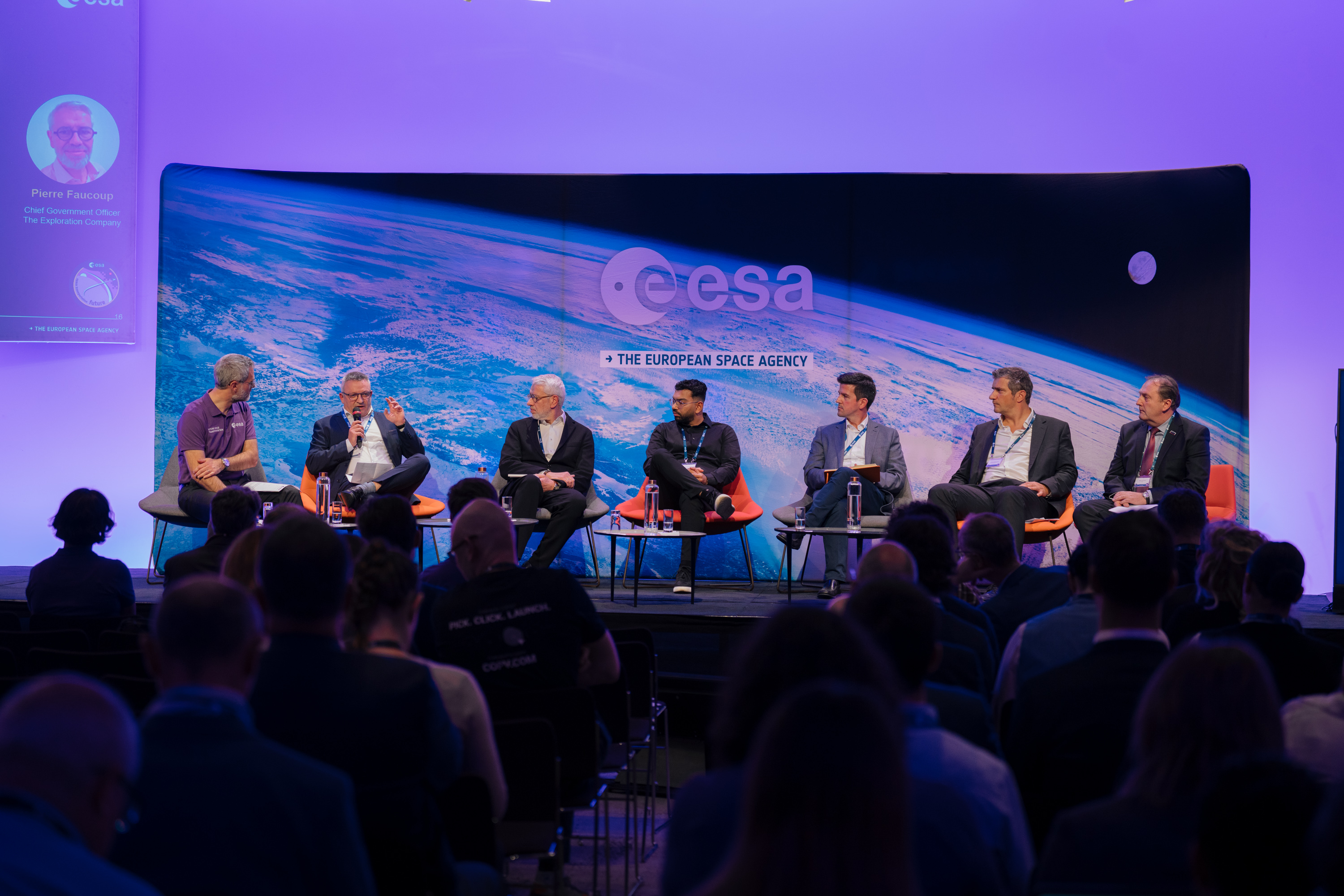
Frédéric Jousset, Themis/Reusability Space Transportation Programme Manager at ESA FLPP, moderates the Dual-use and Defence panel at the Future Space Transportation Autumn Session 2025
As Agata Jozwicka-Perlant, the Future Space Transportation System Manager in FLPP, explained, Europe’s next step must be cooperative:
“We need to ensure European autonomy by securing infrastructure of sovereignty. The challenge now is to produce more, faster – and European. That means working together across borders and keeping all critical technology within reach.”
This practical cooperative approach meets Europe’s growing demand for launch capacity and in-orbit transport services. When no single European country or company can meet the demands alone, “the response must be collective,” said Jozwicka-Perlant, “with deeper cooperation, stronger coordination, and shared investment in capability. Europe must avoid fragmentation and accelerate the emergence of new technologies and new industrial partners.”
Jérôme Dufour of ArianeGroup echoed this need for unity across Europe’s industrial landscape:
“Europe’s internal competition is strong, but others move faster. We need to foster cooperation and create win-win approaches with shared strategy and budgets.”
The spirit of shared progress defines how FLPP operates. Pitch Days and regular workshops bring together system integrators, SMEs, start-ups, investors and mission users from across Europe support the early alignment of developments to fill technological gaps and meet the needs of the end-users. These encounters create partnerships that might not form otherwise, shortening the path from idea to demonstration. By maintaining transparency and reducing overlap, they ensure that partners across Europe are building toward interoperable systems rather than competing in isolation.
The focus on interoperability, early planning and collaboration, and readiness is what many in the European SpaceTech community now see as Europe’s decisive strength. Zygmunt Anioł, Director of the Space Safety Department at the Polish Space Agency (POLSA), reiterated this importance to the audience at ESA’s Future Space Transportation Autumn Session in October:
“Interoperability is key. Space is complex, and no country can act alone. We must understand each other technically, or we lose time – and time is what defines readiness. Interoperability must be prepared before a crisis occurs – and FLPP helps with that by keeping everyone in the same conversation.”
Within FLPP’s technical roadmaps, dual-use perspective is built in from the start. Each project is designed developed with both civil and security relevance in mind, fostering a joint institutional-industrial environment of openness, adaptability, and collective progress.
Short, targeted developments keep momentum high and prevent bottlenecks as companies work to meet higher production targets in shorter timeframes. “The pace of FLPP helps us innovate faster, bridge qualification gaps, and demonstrate what startups can deliver,” explained Rahul Shirke of startup Arceon B.V.
The modular, interoperable systems matured under FLPP – such as propulsion technologies, avionics and GNC interfaces, and in-orbit refilling plans – ensures that these technologies can serve multiple missions and purposes without delay or redesign, keeping Europe responsive, ready, and resilient. “In-orbit servicing and close-proximity operations show what dual use looks like in practice,” commented Paulo Rosa from Indra-Deimos. “Civil missions like debris removal and refilling, and defence operations such as inspection and protection of critical assets.”
From a business perspective, the defence needs can prove to be a practical way to balance orders portfolios and procure resilience to space industrial actors.
“Dual use is the next sweet spot for European’s space transportation business models,” noted Frédéric Jousset, Themis/Reusability Space Transportation Programme Manager at ESA FLPP and moderator of the dual-use and defence panel at the Autumn Session, “and the needs are enormous.”
By supporting industry in developing modular, reusable and interoperable systems, FLPP helps Europe scale faster and protect its autonomy without duplicating effort, expanding the base of expertise and keeping innovation circulating through Europe’s space sector.
With FLPP, Europe builds together, tests together and prepares together – reducing fragmentation and reinforcing collective readiness and relevance.