

The Exploration Company moves ahead with Europe’s first in-orbit docking & refilling demonstration for space transportation
Europe is shaping its capabilities to act in space.
Within ESA’s programme for future space transportation, FLPP, In-Space Proof-of-Concepts (InSPoC) is now entering its consolidation toward final implementation and in-orbit demonstration. The Exploration Company has been awarded the contract for the Consolidation Phase (~Phase B2) of InSPoC-1, marking the next step toward demonstrating Europe’s capability for orbital rendezvous, docking, and non-cryogenic refilling.
The InSPoC venture is aimed at providing Europe with key capabilities to act in space, working toward enabling an in-space logistics ecosystem. InSPoC-1 focuses on the capabilities that make in-space logistics possible – in-orbit rendezvous, docking, and propellant transfer between spacecraft.
These capabilities are essential to Odyssey, ESA’s future flagship programme deploying in-orbit refilling services, which will enable a wide range of applications, from distributed in-orbit refilling in the vicinity of Earth, which serve dual-use applications, to centralised orbital propellant depots, which support exploration missions.
“Europe has a timely window of opportunity to secure a leading role in the orbital economy and to ensure the resilience of its space infrastructure. The InSPoC-1 project is a foundational step in this direction,” said Yann Tincelin, InSPoC Manager. “InSPoC-1 is spearheading a coordinated approach in Europe to ensure that future spacecraft can operate together through shared, interoperable interfaces.”
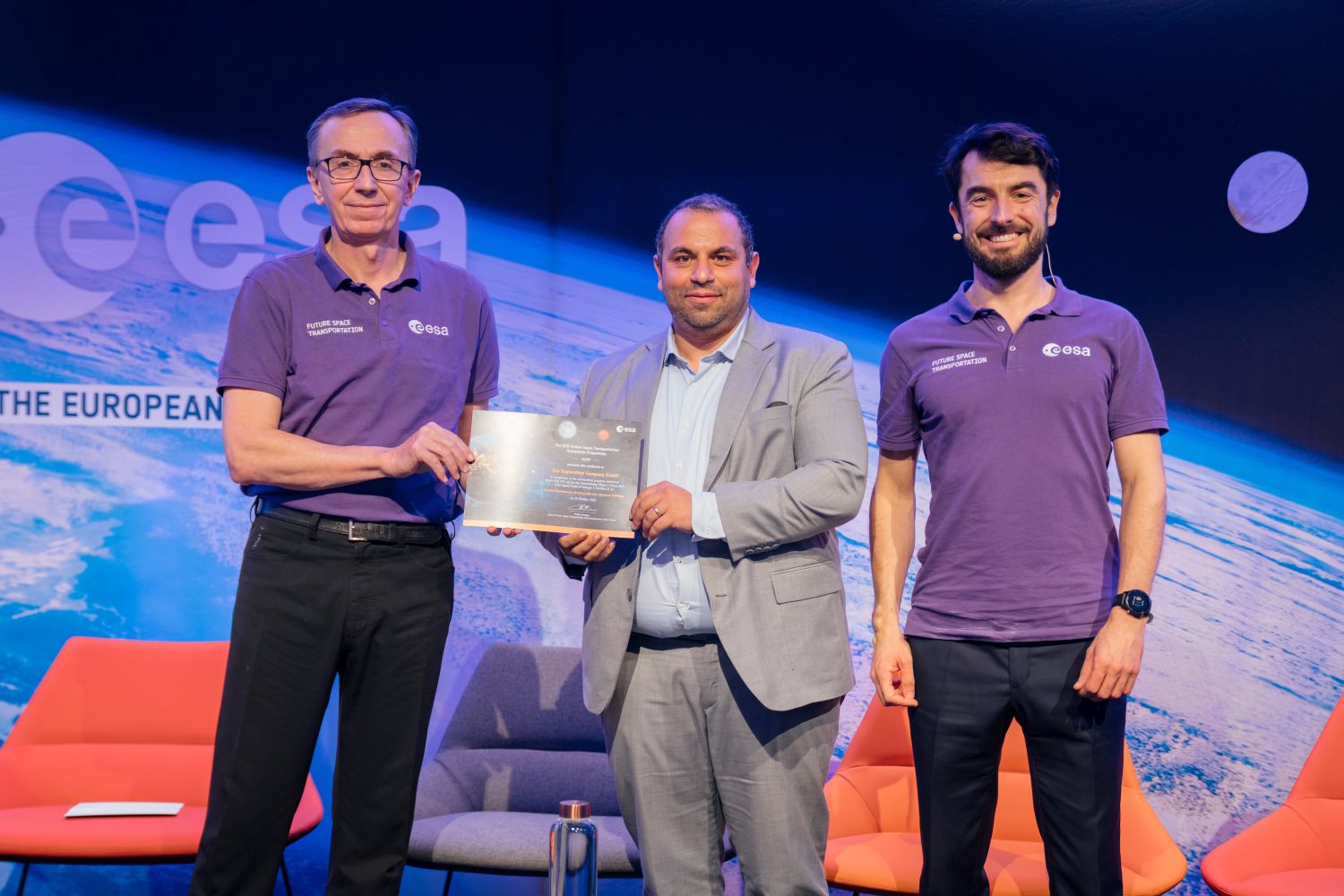
Jérôme Breteau, Head of Future Space Transportation at ESA; Benjamin Kawak, The Exploration Company; and Yann Tincelin, InSPoC Manager
InSPoC-1 will derisk, demonstrate and share with the SpaceTech ecosystem two key interfaces referred to as Minimum Viable Products (MVPs):
- MVP-1 pertains to rendezvous guidelines & GNC-related interfaces, that will be released to ensure different spacecraft can perform safe collaborative rendezvous together, with shared visual markers and high-level rendezvous protocols,
- MVP-2 is related to the Docking and Refilling interface, promoting modularity and interoperability, with a release of the agreed technical interface specifications (known as the Interface Control Document, ICD), fostering a wide adoption of its passive side, and leaving most of the active side open for innovation.
Following a competitive procurement process under FLPP, the Consolidation Phase contract for InSPoC-1 has been awarded to a European consortium led by The Exploration Company from Germany.
The Exploration Company’s award was announced at the FLPP Autumn Session in Paris, where ESA presented recent milestones across Europe’s in-space transportation efforts.
“InSPoC-1 is about execution and adoption. In Phase B2 we take docking, refilling, and power-data transfer to a prototype proven in a relevant environment. We will channel results through the Users’ Club and the Standardisation Committee so primes and SMEs can align on practical interfaces. That is how Europe scales safe in-orbit services,” said Hélène Huby, CEO of The Exploration Company.
InSpoC-1 project flyerThe InSPoC-1 Consolidation Phase will refine system designs, integrate industrial inputs and prepare for the flight demonstration to follow. The final stages, including the in-orbit demonstration, are part of the FLPP proposal for CM25. The enabling interfaces (MVPs) will be consolidated during the ongoing Phase B2 with industry partners and released with open interface architectures, free of export-control, to allow a wide adoption and seamless integration of these interfaces and capabilities.
These are pre-requisites to ensure European stakeholders operate, interact and provide services within the upcoming orbital market. The aim is to strengthen technical harmonisation and promote interoperability across Europe’s in-space logistics capabilities, and to allow European actors to deploy new services in the orbital economy.
The in-orbit demonstration is planned for 2028, when two spacecraft, Oura, developed by The Exploration Company, and EROSS, from Thales Alenia Space France, will perform a full sequence of rendezvous, docking, and refilling in orbit.
By demonstrating technologies incrementally, FLPP brings key components of the future space transportation ecosystem to market faster. This stepwise approach accelerates progress while reducing cost and risk for European companies.
The current design status, shared reference architecture and next steps for the MVPs will be presented to the European SpaceTech community at the In-Space Transportation Club Session #4 on 9 December 2025.
Each milestone in the InSPoC roadmap moves Europe closer to operational in-space transportation: connecting industrial capability, shared interfaces and sustainable orbital infrastructure.
Join the club