

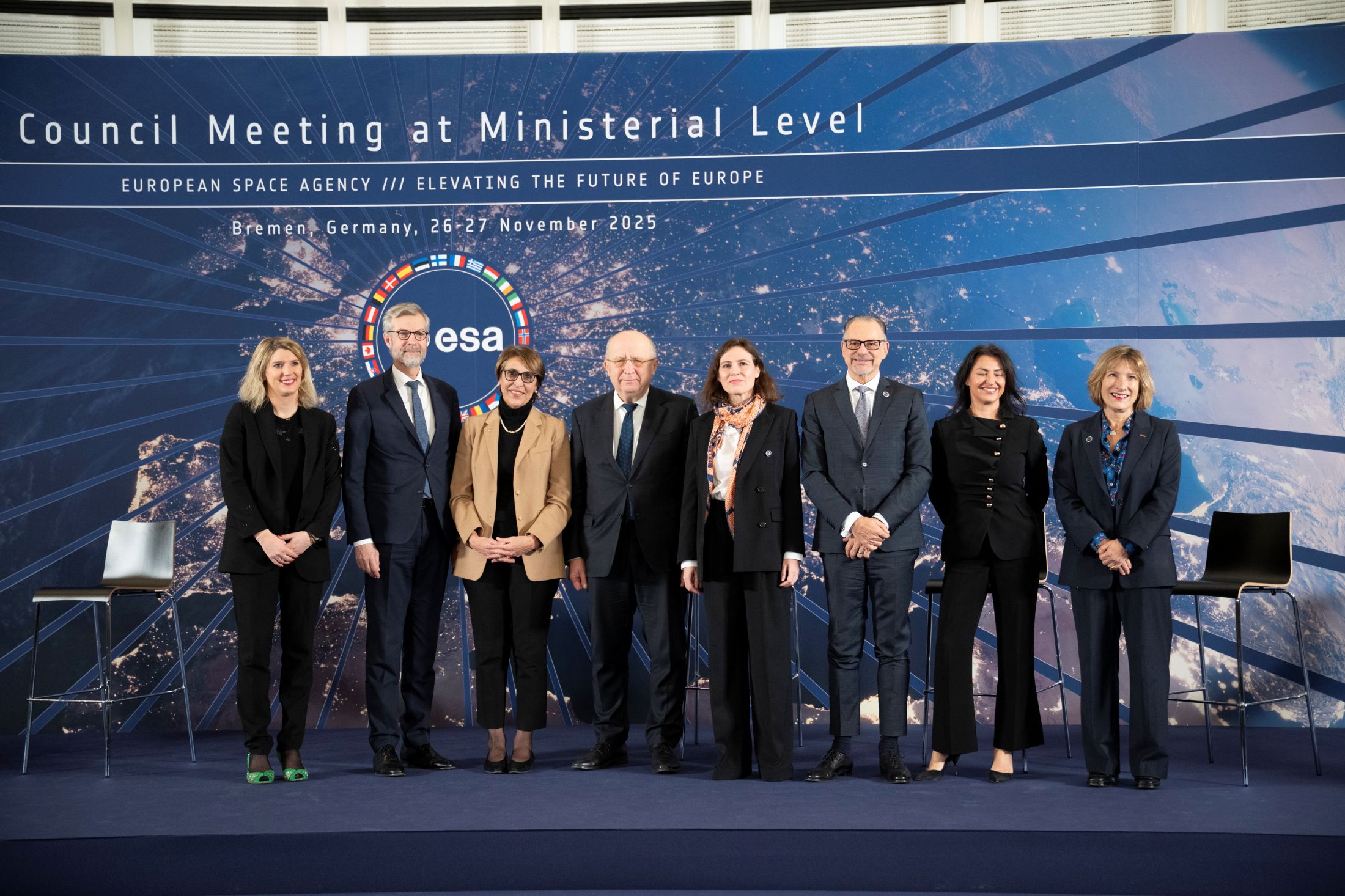
Photo (Left to Right)
Catherine Bender – Head of Division, Financial Institutions Western Europe, European Investment Bank (EIB)
Robert de Groot – Vice President, European Investment Bank (EIB)
Anna Roscio – Executive Director Sales & Marketing Imprese, Intesa Sanpaolo
Andrius Kubilius – European Commissioner for Defence and Space
Rebeca Godoy – Managing Director and Head of Public Sector in Europe, Deutsche Bank
Josef Aschbacher – ESA Director General
Michela Cicenia – Co-Head of Global Trade, Corporate & Investment Banking, Natixis CIB
Géraldine Naja – Director Commercialisation, Industry and Competitiveness, ESA
Announced at ESA’s Ministerial Council on 26th November 2025, The European Investment Bank (EIB) is setting up its first dedicated lending envelope for the European space sector under its TechEU initiative.
The EIB Space Lending Facility is a financing initiative to support Europe’s space ecosystem, by addressing a structural gap in access to credit for SMEs and mid-caps. It supports the development of Europe’s industrial base, strengthens supply-chain resilience, and enhances strategic autonomy by enabling commercial banks to lend more widely to companies active across the space value stream.
This EIB initiative is jointly supported by ESA and the European Commission, and is expected to mobilise an estimated €1.4 billion in the coming years. It represents the next phase of industrial re-scaling and ensures that Europe remains competitive and sovereign in space technology.
ESA Director General Josef Aschbacher said, “This EIB Space Lending Facility marks a decisive milestone for Europe’s space industry. This new instrument will enable further industrialisation and represents a significant step towards strengthening Europe’s technological sovereignty in space.“
ESA as a Strategic Partner
“For over twenty years, space SMEs have struggled to access loans on favourable terms. Through our collaboration with the EIB, ESA can apply its technical and business expertise to ensure this new lending instrument is well designed and effectively implemented. ESA will provide market intelligence, technical due-diligence support, and coordinated outreach, while helping financial intermediaries with sector training and vetted pipelines to maximise impact for European space SMEs and mid-caps.” Géraldine Naja, Director of Commercialisation, Industry and Competitiveness, ESA.
“With this lending envelope – the first dedicated to space – the EIB is targeting Europe’s most pressing financing gaps, from SMEs and mid-caps to the full industrial supply chain. In close collaboration with financial institutions across Europe, and with strong support from ESA and the European Commission, we intend to deploy this instrument rapidly and drive the scale-up and industrialisation of Europe’s space sector.” Catherine Bender, Head of Division, Financial Institutions Western Europe, European Investment Bank.
Working with the European Banking Sector
Senior executives from three major European banks, part of ESA’s Investor Network, joined the discussion on Wednesday evening to provide their support for this initiative. Anna Roscio (Intesa Sanpaolo), Michela Cicenia (Natixis CIB) and Rebeca Godoy (Deutsche Bank) shared their perspectives on the space sector and its financing challenges and opportunities, as well as what they see as the role of ESA in supporting their activities. The EIB Space Lending Facility will further leverage ESA’s Investor Network to familiarise lenders with space-sector dynamics.
Why it Matters for ESA
Access to debt financing remains one of the most persistent bottlenecks for European space firms. Many SMEs and mid-caps face structural difficulties accessing bank loans due to long development cycles, intangible assets, milestone-based revenues, and limited collateral. Strengthening private-sector financing is essential for industrial continuity, competitiveness, and Europe’s ability to deliver on strategic, commercial, and institutional missions.
The Space Lending Facility complements ESA programmes by ensuring that firms supported through ESA contracts, technology maturation activities, and downstream programmes have access to the capital needed to scale. It also complements existing EU instruments like CASSINI and InvestEU, while filling a unique debt-financing gap.
Together, these elements strengthen CM25’s outcome by demonstrating credible investor commitment, unlocking new financing pathways, and reinforcing ESA’s role as a catalyst for commercial growth in Europe’s space ecosystem.
From ESA, these activities are led by the Ventures and Financing Office from the Directorate of Commercialisation, Industry and Competitiveness.


