

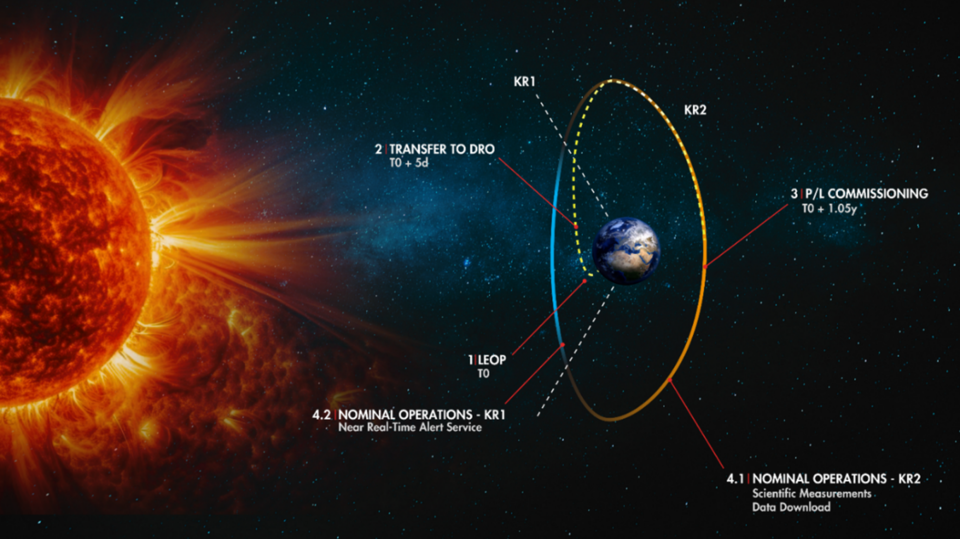
The European Space Agency (ESA) is preparing to launch Henon, its first stand-alone deep-space CubeSat. Unlike previous CubeSats, Henon will operate independently in deep space, without the support of a larger parent spacecraft. The mission’s primary objective is to demonstrate advanced technologies for solar storm forecasting, with the aim of providing earlier warnings to operators of critical infrastructure on Earth.
Innovation and Industry Impact
Henon will be the first CubeSat to perform significant manoeuvres and communicate directly with Earth from deep space. This is made possible by a new miniaturised deep-space transponder and a tailor-made electric propulsion system. These technological advancements are expected to create new commercial opportunities for low-cost missions to destinations such as the Moon, asteroids, and Mars orbit.
Industrial Collaboration and Programme Alignment
The mission is led by Argotec, which has completed the spacecraft’s detailed design and successfully passed the Critical Design Review. The project demonstrates strong collaboration and technical excellence within the consortium, positioning Argotec and its partners at the forefront of miniaturised space technology. Henon is funded through ESA’s General Support Technology Programme (GSTP), which supports the development and demonstration of pioneering technologies with practical applications. The mission is closely aligned with ESA’s strategy to foster innovation and support the competitiveness of European industry.
Value for Critical Infrastructure and Future Prospects
Henon is designed to provide solar storm warnings up to three to six hours in advance, a significant improvement over current capabilities. This extended warning time is expected to deliver substantial value to operators of power grids and other essential services, helping to reduce the risk of disruption and damage. The mission also serves as a technology demonstrator, with the long-term goal of enabling a constellation of small spacecraft in similar orbits. Such a constellation would provide a continuous warning service, supporting new business models for space-based environmental monitoring and resilience.
Read the full article