

“Our goal is not only to generate ideas, but to experiment, to test, to learn, and to collaborate. Because here in Redu, innovation is not a slogan, it’s a mindset.” With these words, Jean-Luc Trullemans, Head of ESA’s European Space Security and Education Centre (ESEC), set the tone for the opening of the ESA Acceleration Days: Accelerate Crisis Preparedness, which kicked off on Monday, 20 October in Redu, Belgium.
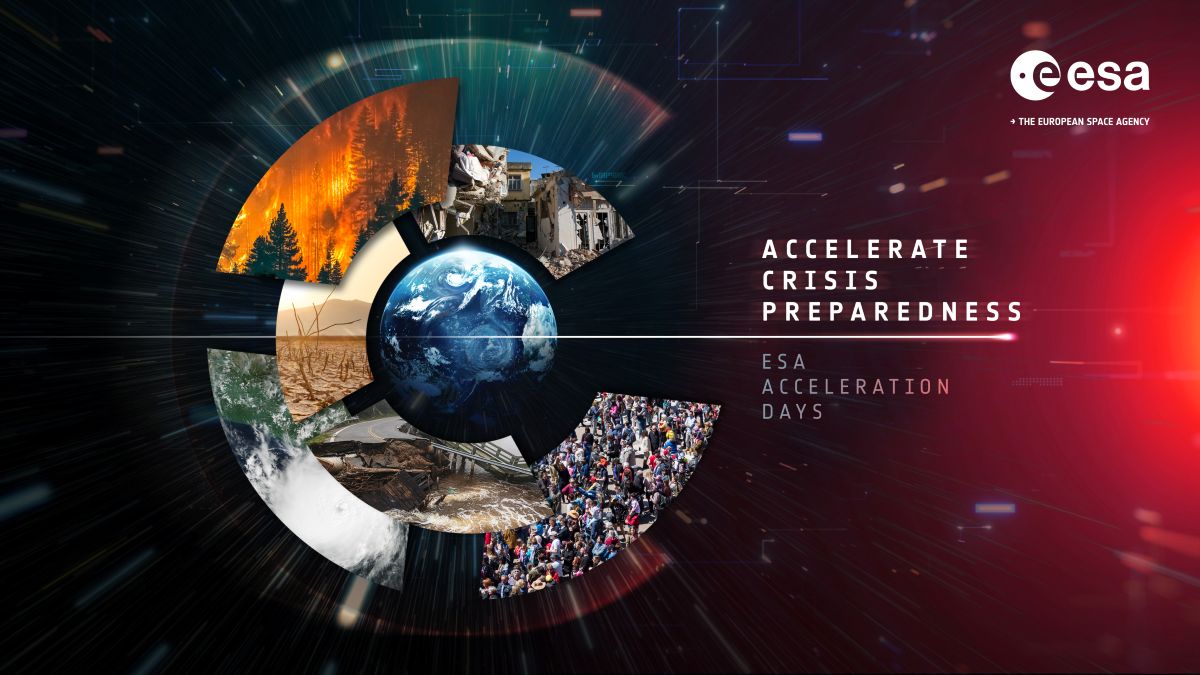
The competition brought together eight multidisciplinary teams united to tackle one bold challenge designed in partnership with safe.brussels and the Local Police of Brussel South: to leverage AI to improve integration of space capabilities to support the preparedness and execution of mass evacuations. Modelled after fast-paced competition formats such as hackathons and innovation sprints, the ESA Acceleration Days are in-person events where top teams compete to take forward their innovation ideas to help tackle Europe’s most pressing issues, with security and resilience as central pillars of its vision.
Context & Challenge
In moments of crisis, every second counts. Whether it is a natural disaster, large-scale accident, or sudden emergency, the ability to plan and execute mass evacuations efficiently can reduce physical and psychosocial harm as well as save lives. Innovators were called to harness the power of space – from satellite navigation and communications to geospatial intelligence – for mass evacuation preparedness, starting from a concrete use case: the mass evacuation of a stadium affected by a crisis.
A total of 34 participants joined the Innovation Sprint onsite, with additional team members connecting remotely to support the prototyping process. Representing multiple countries, the following companies competed in this edition:
- CS Group
- Excelerate
- FARI – AI for the Common Good Institute Brussels
- NTT Data
- Sensorbite
- Thales Spain
- Trillium Technologies
- Consortium of PeaceEye and World-Direct
To support their work, participants were also provided with a curated dataset of projects in the crisis domain leveraging on space capabilities and crisis management initiatives to support the development of their solution prototype during the event.
Guided by Users, Driven by Innovation
ESA Acceleration Days: Accelerate Crisis Preparedness also saw the support of a wide-ranging effort, as teams were guided by a group of dedicated 20 mentors, 5 facilitators, and ultimately pitched to 8 high-level jurors. Their expertise and engagement throughout the event played an essential role in empowering participants and ensuring the event’s overall success. Beyond supporting the teams throughout the Sprint, many of the mentors also contributed insightful keynotes that enriched the event’s content and inspired participants. The keynote programme included a variety of partners, including representatives from safe.brussels, Local Police Brussels South, the European Space Agency, Starion, and RSC Anderlecht.
Solution Rewarded
The Sprint concluded with final pitches, where teams walked the jury through the journey behind their prototypes, highlighting the problem addressed and a commercialisation plan for further development. These presentations offered a clear and compelling view of each innovation’s potential real-world impact.
While all teams delivered impressive results in their prototype maturity, the winning project was be.safer, developed by the Trillium Technologies team. The prototype stood out for its innovative approach to enhancing the preparedness for, and execution of, mass evacuations. Addressing the challenges faced by crisis managers and decision-makers, such as inefficient communication and use of resources, be.safer offers a platform for Brussels powered by a space-enabled toolbox that enables real-time decision-making. The Trillium Technologies team has now been invited to apply for an ESA Cooperative Agreement, valued at up to €100,000, to further develop this winning tool. This support will enable the team to refine their solution, explore its scalability, and bring it closer to real-world implementation.
Conclusion: From Orbit to Action
ESA Acceleration Days: Accelerate Crisis Preparedness demonstrated the power of collaboration, creativity, and space-based innovation in tackling crisis preparedness challenges. By bringing together diverse teams and committed stakeholders, the event created a fertile ground for bold ideas to take root and grow into actionable solutions.
Here are a few pictures from the event.


