ESA title

CONTACT US

Learning Hub The ESA Learning Hub is a web-based platform which provides access to training courses and materials linked to ESA programs and initiatives

Matchmaking ESA-Match is a platform that lets companies showcase their competences and capabilities, find partners, explore commercial opportunities and establish business relationships

Intellectual Property ESA makes its intellectual property available to European space companies within its 22 Member States, on a freely-licensed basis

ESA Patents

CONTACT US

    * Mandatory field

    News

    ESA Launches the Second Space Resources Challenge (SRC)

    The European Space Agency (ESA), in collaboration with the Luxembourg Space Agency (LSA) and the European Space Resources Innovation Centre (ESRIC), is hosting the Second Space Resources Challenge (SRC). This initiative aims to advance technologies for the excavation and beneficiation of lunar regolith, which are crucial for future lunar missions and sustainable human presence on the Moon.

    The Challenge

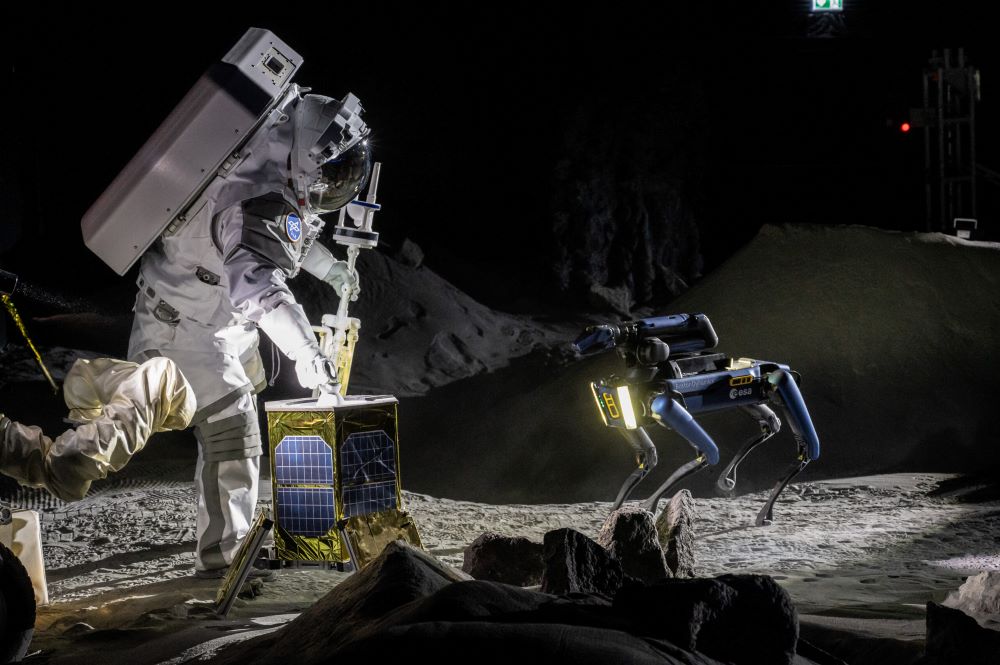
    The challenge focuses on developing technologies for the excavation (collecting and handling lunar soil) and beneficiation (improving the quality of collected material) of lunar regolith. Participants will design and operate robotic systems to collect and sort lunar regolith simulant. The event will be held at LUNA, a 700m² facility replicating the Moon’s environment, including lighting and gravity conditions.

    The best performing team overall will receive a €500,000 development contract for a feasibility study with ESA. The top team in the Beneficiation category will be awarded up to €250,000 by LSA and ESRIC. In total, participants can win up to €750,000.
    LUNA Facility. Credits: ESA/DLR

    Objective and Mission Scenario

    Participants in the SRC will operate within a simulated mission scenario set in the 2040s, where operations to sustain a long-term human presence on the Moon using lunar resources have begun. End-to-end In-Situ Resource Utilisation (ISRU) processes have been demonstrated via robotic and crewed missions, with small-scale production of ISRU products such as oxygen and metals. Integrated systems to extract, process, and store lunar resources are in place, supporting activities like additive manufacturing for construction and refueling.

    The objective is to develop technologies that can efficiently excavate and beneficiate lunar regolith, preparing it for further processing. This is crucial for producing resources like oxygen and metals, which are essential for sustaining human presence on the Moon.

    If you have the expertise to design and operate robotic systems for lunar regolith processing, click on the button below to submit your proposal by 20 February 2025.

    Submit your proposal
    Related Pages

    Related news

    19 January 2026
    Maturing Dual-Use Capabilities with FLPP: the Next Sweet Spot for European Industry

    Space has long been integral to European society. Navigation, communication and observation systems have supported both civil and defence needs for decades – connecting communities, protecting infrastructure and enabling rapid...

    16 January 2026
    Advances in Europe’s Space Logistics Capabilities: Updates from InSPoC-2 and InSPoC-3

    The European Space Agency’s in-space transportation activities continue to progress with FLPP, ESA’s programme for future space transportation. In-Space Proof-of-Concepts (InSPoC) 2 and 3 have now completed their current phases,...

    15 January 2026
    EPIC Health from Space Competition

    In the framework of the fourth edition of the international Health from Space Conference & Exhibition, the European Space Agency is pleased to announce the launch of the 2026 EPIC...

    09 January 2026
    IPN and Técnico Selected by ESA to Run the New ESA BIC Centres in Portugal

    Over the next three years, the ESA BIC programme will be implemented in Portugal through two consortia led by Instituto Pedro Nunes and Instituto Superior Técnico. The programme supports start-ups,...

    04 December 2025
    ESA Phi-Lab UK funding awarded to address sustainable agriculture and space environmental challenges with AI

    Oxford spinout and London start-up selected for AI projects in carbon monitoring and space environmental intelligence Deep Planet and Space DOTS have been selected as the first cohort of the...

    Keep updated on all ESA opportunities

    Subscribe to our newsletter or visit our Help page for quick answers

    Subscribe to newsletter Get Help